Silogism represents a foundational element in the realm of logic, forming a vital component of deductive reasoning. Originating from ancient Greek philosophy, it serves as a method for drawing conclusions from given premises, a practice essential for coherent discourse and argumentation. Understanding silogism enhances critical thinking skills, providing a rigorous framework for evaluating the validity of arguments across various disciplines.

Silogism is a crucial concept in the study of logic and critical thinking. This method of deductive reasoning traces its roots back to ancient Greek philosophy, particularly within the works of Aristotle. A silogism consists of two premises leading to a conclusion, offering a structured way of forming sound arguments. This logical methodology underpins much of Western thought, influencing disciplines from mathematics to computer science. The understanding of silogism not only contributes to academic fields but also plays a pivotal role in everyday reasoning and decision-making processes. In this modern age, where information is readily available yet often convoluted, being well-versed in silogistic reasoning equips individuals with the tools to dissect and analyze the world around them more effectively.
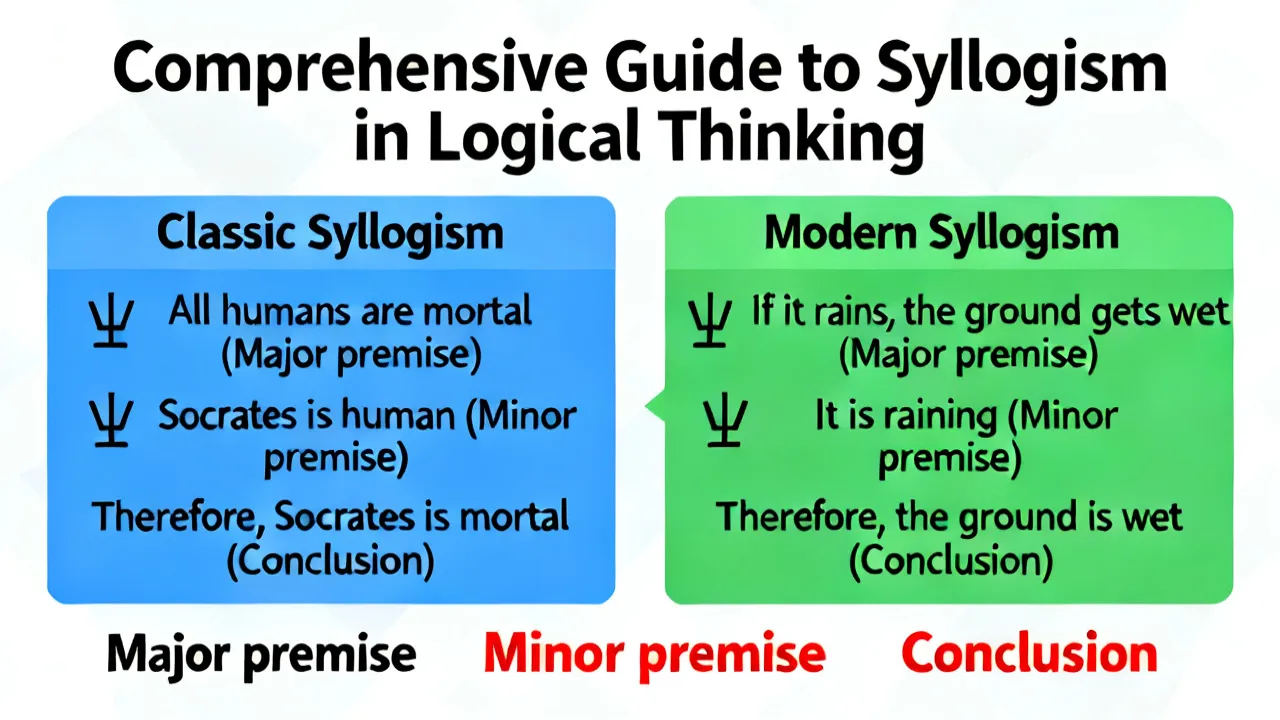
At its core, a silogism comprises three parts: the major premise, the minor premise, and the conclusion. Each of these elements plays a unique role in forming a cohesive argument. For instance, in the famous example, "All humans are mortal (major premise). Socrates is a human (minor premise). Therefore, Socrates is mortal (conclusion)," the conclusion naturally follows from the premises, showcasing the power of silogism in establishing logical proof. This structure can be broken down further into different forms, including mood and figure, which categorize the rules and variations that define how different silogisms can be systematically arranged to yield valid conclusions. In this manner, understanding the foundational elements of a silogism allows one to apply them across numerous scenarios effectively.
Although silogism has its origins in ancient philosophy, its applications are remarkably modern. Today, silogism is integral in fields that rely on logical outcomes. In law, for example, legal reasoning often employs silogistic reasoning to determine the culpability or innocence based on statutes and facts presented in court. Legal professionals frequently construct arguments that follow the format of silogism, meticulously ensuring that each premise is conclusive and firmly justified. Similarly, in computer science, algorithms frequently incorporate deductive logic, resembling silogistic patterns to process information and produce reliable results. For instance, in artificial intelligence, machine learning models are developed using foundational principles that echo silogistic reasoning, enabling machines to ‘learn’ from data and make predictions based on logical rules. Furthermore, businesses utilize silogistic reasoning in strategic decision-making processes, ensuring that each choice is aligned with objectives and backed by logical justifications. From board meetings to product development, silogism reinforces clarity and efficiency.
Silogisms can appear in various forms, each providing a different logical perspective. Categorical silogisms, the very direct type, deal with statements that relate categories or classes. For example, "All mammals are warm-blooded (major premise), all whales are mammals (minor premise), therefore all whales are warm-blooded (conclusion)." Hypothetical silogisms, on the other hand, involve conditions and "if-then" scenarios, such as "If it rains, the ground gets wet (major premise), it is raining (minor premise), therefore the ground is wet (conclusion)." Understanding these differences is critical for effectively applying silogistic reasoning in various contexts, from academic debate to strategic decision-making. Another variant is the disjunctive silogism, which involves choices and can be framed as, "Either the light is on or the light is off (major premise); the light is not off (minor premise); therefore, the light is on (conclusion)." Being familiarized with various forms of silogisms empowers individuals to recognize their usage in daily conversations, persuasive writings, and even in the media, where logical coherence is paramount. By differentiating types of silogisms, individuals become adept at identifying which form to apply to their reasoning process, tailoring their approach to the needs of the argument at hand.
The practice of constructing silogisms teaches us how to think critically and analytically. By evaluating premises and their relationship to each other and their conclusion, one develops the ability to dissect arguments, identify logical fallacies, and construct coherent arguments. This critical skill is increasingly vital in an age where information is abundant and not always trustworthy. Silogistic reasoning also cultivates the habit of questioning assumptions and engaging in reflective thinking, which are integral to effective problem-solving. Engaging in exercises that involve formulating silogisms can sharpen one’s reasoning abilities, ultimately leading to enhanced persuasive capabilities. This skill not only benefits academic pursuits but is also invaluable in various professional settings, where logical reasoning is crucial to innovation and effective leadership. Moreover, understanding silogistic reasoning enhances one's ability to communicate ideas clearly and convincingly, which is essential in fields such as marketing, education, and public speaking.
Silogism's historical context provides insight into its profound impact on philosophy and logic. Aristotle's formulation of this logical structure marked a definitive shift in how individuals understood reasoning processes. Whole volumes of work from Aristotle, such as "Prior Analytics," delve into the intricacies of syllogistic reasoning, establishing foundational concepts that continue to be discussed in contemporary logic courses. Over centuries, as philosophical thought evolved, the form and application of silogisms also adapted, reflecting the changing intellectual landscape and becoming a cornerstone of Enlightenment thinking and later logical positivism. The evolution of silogism was not limited to Aristotle; many scholars and philosophers contributed to its development, including medieval logicians like Thomas Aquinas, who integrated areas of theology and philosophy into the structure of silogism, thus expanding its applications. The intersection of silogism with various philosophical movements illustrates how its relevance extends beyond mere academic interest, influencing practical aspects of human reasoning, ethics, and scientific inquiry. Throughout the Renaissance and into the age of Enlightenment, silogistic reasoning remained a critical part of scholarly discourse, facilitating advancements in science and philosophy by promoting criteria for valid inference and logical structure.
| Type | Description |
|---|---|
| Categorical Silogism | Relates categories or classes using universal statements, establishing connections between groups. |
| Hypothetical Silogism | Involves conditional "if-then" scenarios for reasoning, demonstrating outcomes based on premises. |
| Disjunctive Silogism | Proceeds by eliminating possible options through "either-or" statements, resolving queries through clear distinctions. |
To fully grasp the application of silogism in everyday reasoning, engaging in practical exercises is essential. One effective method is to create your own silogistic statements based on premises that pertain to your daily life. For example, consider the following exercise:
By going through this process, individuals can familiarize themselves with building solid arguments based on logical premises. This exercise can be further enhanced by discussing these arguments with peers, allowing for collaborative feedback and critical analysis.
What is the purpose of a silogism?
The purpose of a silogism is to provide a logical framework for deducing conclusions from two or more premises, effectively supporting valid reasoning. It helps to clarify thoughts and ensures that arguments are structured coherently.
Can silogisms be applied in everyday decision-making?
Yes, silogisms can help evaluate everyday decisions by breaking complex scenarios into basic, logical steps, ensuring decisions are based on reasoned analysis rather than emotion. This logical approach can lead to better outcomes and more justified choices.
Is silogistic reasoning difficult to learn?
While silogistic reasoning can seem complex at first, with practice and exposure to different examples, it becomes an invaluable tool for logical thought. Understanding its principles helps reinforce clarity in argumentation.
How can one improve their ability to construct silogisms?
Improving one's ability to construct silogisms can be achieved through practice. Engage in brainstorming sessions, study classic examples of silogistic reasoning, and participate in discussions or debates where constructing logical arguments is necessary. Using logic puzzles or formal logic exercises can also enhance analytical skills.
How does silogism relate to critical thinking in educational settings?
In educational settings, teaching students about silogism fosters critical thinking by encouraging them to analyze and evaluate arguments critically. It helps students develop the ability to reason logically, form hypotheses, and validate their conclusions, which are essential skills in all disciplines.
In conclusion, silogism remains a potent tool across disciplines. Its continued relevance underlines the enduring significance of clear, logical thinking in a rapidly evolving world. By mastering silogistic reasoning, individuals can harness its potential to navigate and understand complex information efficiently. The investment in understanding this logical framework not only enhances personal reasoning capabilities but also cultivates a more substantiated approach to addressing issues and making informed decisions in life.