This article explores the concept of silogism, a form of reasoning in logic. Silogism involves drawing conclusions from two premises, ensuring deductive reasoning is implemented in analytical processes. Understanding silogism is essential for enhancing critical thinking and decision-making abilities across various fields, from philosophy to computer science.

The concept of silogism, derived from the Greek term "syllogismos," refers to a logical argument that applies deductive reasoning to arrive at a conclusion based on two or more propositions assumed to be true. This form of reasoning is foundational in classical logic and plays a pivotal role in the realms of philosophy, mathematics, and computer science, among others. Understanding silogism offers insights into the mechanics of reasoning, allowing us to better dissect arguments and improve our rational thinking abilities.
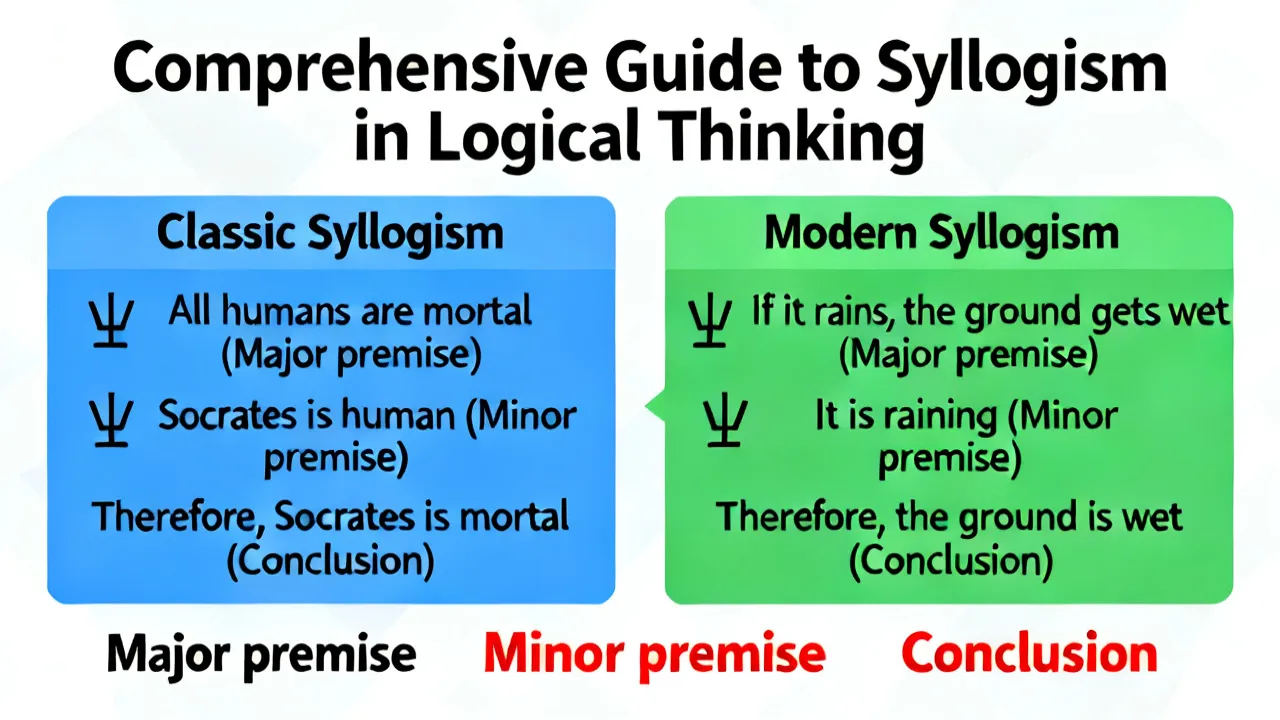
A typical syllogism consists of three parts: a major premise, a minor premise, and a conclusion. The premises provide the grounds for the conclusion, which may be immediately or derivatively reached. For instance, in the celebrated example:
This syllogism demonstrates how known facts can be linked to draw a logical and rational conclusion. Each component of a syllogism plays an integral role in constructing a logical argument. If the premises are true, it follows logically that the conclusion must also be true, illustrating the strength of deductive reasoning.
To further understand the structure of syllogism, we can explore different forms and types, such as categorical syllogisms, hypothetical syllogisms, and disjunctive syllogisms. Each of these variations presents a unique way of processing logical thought. For example:
Understanding these variations allows for greater flexibility in applying syllogistic reasoning across diverse circumstances, whether in philosophical arguments, academic discourse, or everyday decision-making scenarios.
The applications of silogistic reasoning are vast and varied. In the domain of philosophical discourse, silogism allows philosophers to construct sound arguments that explore complex existential questions. By rigorously applying logical structures, philosophers can examine the validity of their claims and the implications of their assertions. For instance, ethical debates often utilize syllogisms to distill foundational principles into clear, actionable conclusions.
In computer science, logic gates and algorithms often rely on deductive reasoning akin to silogism to process information efficiently. The use of logical operators in programming languages is fundamentally rooted in syllogistic principles, enabling tasks such as decision making, problem solving, and creating algorithms that teach machines how to perform human-like reasoning processes. Logical constructs form the basis for artificial intelligence, automation, and machine learning, driving forward advancements that change the landscape of technology.
Moreover, critical thinking education frequently leverages these logical structures to enhance reasoning skills among students. In educational settings, instructors often use syllogisms to teach students how to build arguments, evaluate evidence, and differentiate between sound reasoning and fallacies. This method not only sharpens students' analytical capabilities but also prepares them for complex problem-solving scenarios in both academic and real-world contexts.
Beyond the classroom, syllogism plays a crucial role in fields like law, where constructing logical arguments is essential for persuasive legal reasoning. Lawyers commonly employ syllogisms to underscore their points during litigation, helping juries and judges to follow the logical progression of cases presented in court. In medical diagnostics, health professionals use similar structures for clinical reasoning, allowing them to rule out diagnoses and determine patient treatment based on observed symptoms.
Aristotle was one of the first philosophers to formalize syllogistic logic. His works provided a systematic framework for analyzing arguments, laying the groundwork for future philosophical inquiries. Aristotle's "Prior Analytics" outlines several types of syllogisms and describes the principles underlying valid reasoning. The clarity with which ancient philosophers articulated these concepts paved the way for scholars throughout history to explore and expand upon these ideas.
With time, philosophers like Immanuel Kant further expanded these frameworks, interpreting and applying them in diverse philosophical contexts. Kant’s views on categories and the role they play in human experience demonstrate how syllogistic reasoning can intersect with discussions of metaphysics and epistemology, challenging and enriching our understanding of knowledge.
In the 20th century, Ludwig Wittgenstein contributed to the evolution of logical reasoning through his investigations into language and meaning. Wittgenstein’s work prompted reevaluations of logical deduction, encouraging a more nuanced application of syllogistic reasoning in contemporary discourse. His influence heralded an era where logic not only examined formal structures but also the semantics of language and its implications in understanding thought processes.
The evolution of silogism continues in academia, driven by its applications in formal logic and artificial intelligence. As new developments arise within fields such as linguistics and cognitive science, the principles of syllogistic reasoning are being revisited and reinterpreted, enhancing our comprehension of human cognition and its relationship with logic. Researchers today explore algorithms that mimic human reasoning, utilizing principles established through classical syllogism to optimize machines’ decision-making capabilities.
In contemporary settings, silogism remains crucial in developing artificial intelligence and programming languages, forming the backbone of many machine learning protocols. By employing logical structures, computer programs are taught to make decisions similarly to human reasoning processes. This includes the interpretation of natural language, as sophisticated algorithms enable machines to parse sentences and derive meaning, replicating complex human reasoning patterns.
The advent of advanced computational technologies has led to an increased emphasis on logical frameworks in various domains. For instance, the legal tech industry employs algorithmic systems that analyze large volumes of legal texts. These systems often utilize syllogistic principles to extract relevant information, thereby assisting lawyers in building cases and improving the efficiency of legal research. Moreover, in the medical field, AI systems are being designed to analyze symptoms and recommend diagnoses, operating under logical frameworks built from vast datasets of medical knowledge.
As the field expands, new applications of this time-tested logical form continue to emerge. Organizations are using syllogistic reasoning as part of their decision-making processes, ensuring that conclusions drawn from data are logically sound and defendable. In business strategy, executives utilize syllogistic frameworks to analyze market trends and make informed decisions based on the interrelationships between various factors affecting their organizations.
Despite its effectiveness, the application of syllogistic reasoning is not without its challenges and critiques. One critique is that syllogisms can sometimes oversimplify complexities of real-world situations. As logical frameworks strip down arguments to their fundamental components, nuances might be overlooked, leading to conclusions that do not adequately reflect the intricacies of human experience. This becomes especially evident in ethical discussions, where moral dilemmas often resist binary classifications central to syllogistic logic.
Another concern is that not all premises are universally accepted or easily verifiable. In arguments rooted in subjective experiences or beliefs, premises may be debatable, potentially leading to a conclusion that some may find unconvincing. This criticism emphasizes the need for a robust examination of the premises used to construct syllogisms. Rigorous scrutiny of the truthfulness and relevance of premises is essential in ensuring that the conclusions drawn from syllogistic arguments are sound.
Furthermore, reliance solely on syllogistic reasoning may hinder creative thinking. While structured logical reasoning is beneficial for deductive reasoning, overemphasis on formality might stifle innovative approaches and lateral thinking crucial in problem-solving discussions. Modern thinkers encourage a balanced approach that incorporates both syllogistic logic and creative methodologies, creating a more holistic understanding of reasoning and argumentation.
Understanding silogism is not merely an academic exercise; it has practical importance in numerous fields. It enhances critical thinking, provides a foundation for logical analysis, and supports decision-making processes. As we delve deeper into an era dominated by information and digital interfaces, the significance of this logical framework is bound to grow. Engaging with syllogism equips individuals to navigate complex scenarios, articulate their thoughts with clarity, and evaluate arguments critically, skills that are incredibly valuable in our increasingly interconnected world.
Moreover, the continued evolution of syllogism reflects the dynamic nature of reasoning itself. As we adapt to technological advancements and shifting societal values, the principles underlying syllogistic reasoning will likely evolve in response to new challenges. Embracing these ideas ensures that our capacity for reasoned argument and sound judgment remains robust and relevant, equipping us to engage meaningfully with the complexities of our modern lives.