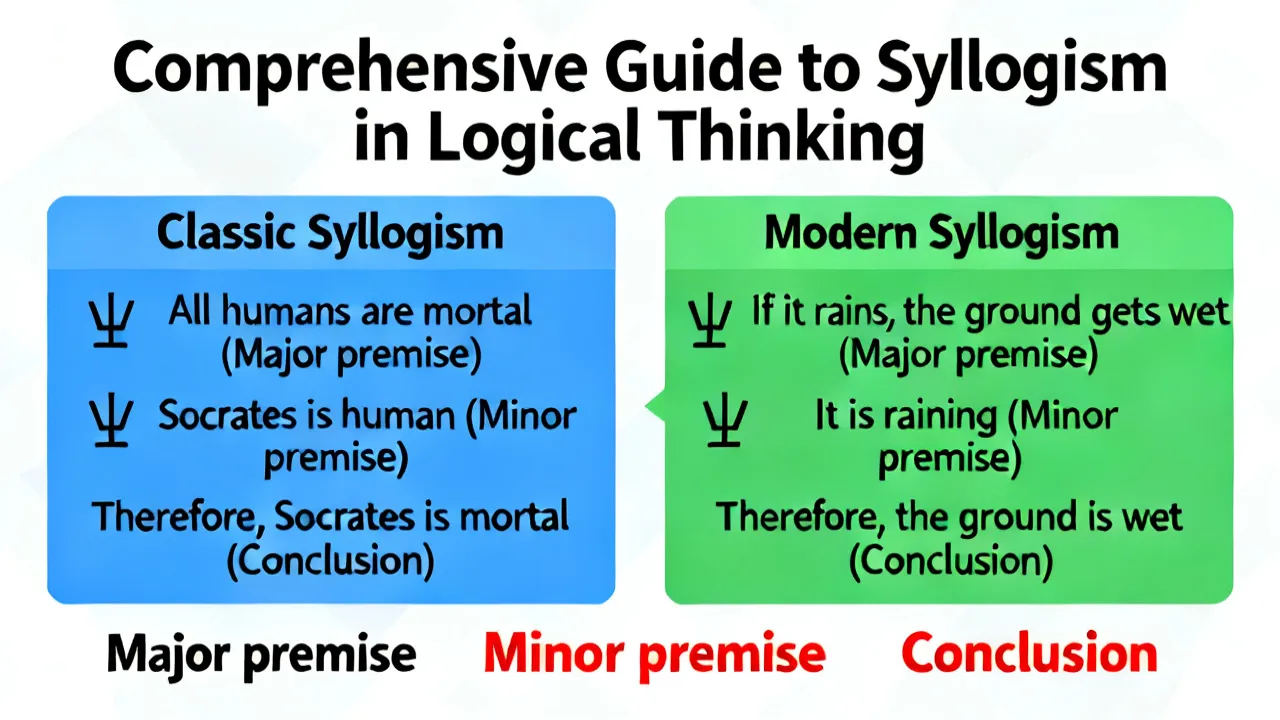
This guide delves into the concept of silogism, a form of logical reasoning that involves drawing conclusions from two given or assumed propositions (premises). Originating from the works of Aristotle, silogism has long been a foundational element in the study of logic and philosophy, emphasizing the deductive reasoning process that bridges logical thought with practical applications.

Silogism is a form of logical reasoning that involves deducing conclusions from two or more given premises. It was systematically developed and studied by the philosopher Aristotle, whose work laid the foundation for classical logic. This logical structure remains central in fields such as philosophy, mathematics, and computer science, where rigorous deduction is essential. The exploration of silogistic reasoning provides a methodical approach to understanding how conclusions are derived and justifies one idea based on the acceptance of others. Through the centuries, silogism has evolved, yet its fundamental principles continue to inform critical thinking practices and argumentation strategies in various academic and professional contexts.
Silogism typically consists of a major premise, a minor premise, and a conclusion. The premises must share a common term with each other, but not with the conclusion, which emerges as a new statement logically derived from the premises. The classic format of logical reasoning not only illustrates the relationship between premises but also showcases how conclusions can be drawn logically. An example of a classic silogism is:
Major Premise: All humans are mortal.
Minor Premise: Socrates is a human.
Conclusion: Socrates is mortal.
This example demonstrates the deductive method, where the conclusion inevitably follows if the premises are true. The essence of silogism lies not only in the correctness of the premises but also in the logical necessity of the conclusion stemming from them. In this context, one can also explore the significance of the terms and their relationships, as identified by Aristotle, like major terms (the predicate of the conclusion), minor terms (the subject of the conclusion), and middle terms (the term that appears in both premises but not in the conclusion).
| Type | Description |
|---|---|
| Categorical Silogism | Involves statements in the form of 'All', 'No', or 'Some' and leads to a conclusion based on these absolute attributes. It provides clarity in arguments where specificity of categories is vital. |
| Conditional Silogism | Often formed using 'if...then' statements, making them similar to scientific hypotheses. These stanements facilitate conditional reasoning by outlining potential implications based on given circumstances. |
| Disjunctive Silogism | Presents two possibilities and eliminates one, thus affirming the other. This method is useful in decision-making processes where multiple options exist, yet only one can be chosen. |
Each type of silogism serves its unique role in rational discourse, bolstering the way arguments can be framed based on different logical structures. For instance, conditional silogisms can be particularly beneficial in scientific discussions, where outcomes are often contingent upon specific conditions being met. Additionally, disjunctive silogisms can be illustrative in situations requiring critical choices, allowing individuals to assess plausible options based on presented premises.
Today, silogism is crucial not just in logical discourse but also in practical applications across various fields. In computer science, algorithms often rely on logical structures akin to silogisms, enabling programmers to create robust logical frameworks for software applications. Programming languages often echo these logical principles in their structure, allowing for the reasoning needed to validate functions or processes. In legal systems, deductive reasoning grounded in silogistic principles forms the basis for case arguments, where lawyers utilize established laws and facts to draw conclusions about case outcomes.
Moreover, within the field of artificial intelligence, silogistic reasoning plays a significant role in enhancing machine learning algorithms, allowing systems to operate under defined conditions and deduce outcomes based on available data. This approach not only aids in data analysis but also encourages the development of systems that can simulate human-like reasoning processes, thus revolutionizing our interaction with technology worldwide.
In the educational sector, understanding and applying silogisms can enhance critical thinking. Students who study logic, philosophy, or even debate techniques find that mastering silogistic reasoning sharpens their analytical skills. By breaking down arguments into their core premises, learners can assess validity and soundness more effectively, equipping them to tackle substantive discussions in a variety of disciplines.
Philosophy students explore these structures to refine their reasoning skills, enabling them to assess arguments rigorously and constructively. In classrooms, exercises in constructing and deconstructing silogisms facilitate lively discussions and enrich students' comprehension of arguments in literature, ethics, and political theory. Furthermore, the practice of silogistic reasoning encourages a habit of clear expression, allowing students to articulate their thoughts with commendable precision.
Beyond academia, the ability to construct sound arguments using silogism translates well into professional fields. In business negotiations, for instance, clear logical structuring can bolster persuasive strategies and facilitate effective communications among team members or stakeholders. Thus, mastering silogism not only benefits intellectual development but also prepares individuals for professional interactions across diverse settings.
The concept of silogism extends far beyond theoretical discourse, finding practical applications in various industries and day-to-day scenarios. Decisions based on logical reasoning frequently arise in everyday situations, illustrating the prevalence of silogistic structures in our lives. For example, voters may analyze the debate between candidates using conditional silogisms, wherein a voter might reason:
If Candidate A supports healthcare reform, and I support healthcare reform, then Candidate A is my preferable choice.
This example showcases how individuals leverage logic to evaluate their options, reflecting the influence of silogistic reasoning in civic engagement.
Additionally, in healthcare, practitioners apply silogistic reasoning when diagnosing patients. The process of determining a patient's condition often follows conditional reasoning: "If a patient exhibits symptom A and symptom B, then they may be diagnosed with Condition X." This approach illustrates how healthcare professionals can derive meaningful conclusions from initial observations and symptoms, allowing for timely and accurate patient care.
Moreover, silogism finds its relevance in technological advancements, including the design of chatbots and virtual assistants. These tools rely heavily on programmed logic that reflects a silogistic framework, processing user inquiries by analyzing the conditional premises embedded within their programming. The chatbots can operate effectively to provide accurate responses based on input scenarios, bolstering customer service endeavors across various sectors, from retail to telecommunications.
Despite the power of silogisms in logical reasoning, it is essential to be aware of common logical fallacies that can arise when formulating arguments. These fallacies demonstrate failure in logical structure and reasoning, leading to invalid conclusions based on seemingly sound premises. Some prevalent fallacies include:
If it rains, the ground will be wet. The ground is wet, therefore it rained.
If it rains, the ground will be wet. It did not rain, therefore the ground is not wet.
All parts of this machine are lightweight, therefore the entire machine is lightweight.
This cake is delicious, therefore each individual ingredient must also be delicious.
Awareness of these fallacies is crucial for anyone engaged in logical reasoning or argumentation. By recognizing these pitfalls, individuals can hone their ability to construct sound silogistic arguments and critically evaluate the claims of others.
Q: Are all arguments in the form of silogisms valid?
A: Not necessarily. For a silogistic argument to be valid, it must adhere to certain rules that ensure the conclusion logically follows from the premises. Validity does not imply truth; a valid argument can still have false premises, leading to a true or false conclusion.
Q: Can silogisms have more than two premises?
A: Typically, a standard silogism has two premises, but complex syllogistic arguments can incorporate additional premises and are known as "polysyllogisms." These complex forms can enhance the depth of discussions or arguments, allowing for more nuanced reasoning.
Q: What makes an argument deductive?
A: Deductive arguments provide definitive proof of their conclusions based on the premises, as opposed to inductive arguments, which suggest probability. The deductive structure emphasizes certainty, allowing for conclusions drawn logically to enable clear and convincing discourse.
Understanding silogism involves appreciating its historical roots and recognizing its contemporary applications. This logical form continues to be a cornerstone in analytical reasoning, blending historical philosophical insights with modern analytical needs. In essence, mastering silogism paves the way for clearer and more persuasive arguments across various disciplines.
In today’s rapidly evolving landscape of information consumption, the efficacy of silogistic reasoning remains pertinent. As individuals navigate debates, discussions, and decisions, the principles of logic derived from silogism provide valuable frameworks. By utilizing these frameworks, individuals can enhance their critical thinking and reasoning capabilities, leading to reasoned judgments and informed choices. In an age where information is abundant, the art of logical reasoning through silogism stands as a beacon for clarity and coherence in understanding the world around us.
Ultimately, the study and application of silogism enrich not only one’s intellectual pursuits but also everyday life encounters and interactions, promoting a culture of thoughtful dialogue and informed citizenry. Whether in academia, professional fields, or personal discussions, the enduring legacy of silogistic reasoning continues to play a transformative role in how we think, argue, and arrive at conclusions.