
Silogism forms the foundation of deductive reasoning, playing a significant role in logical thinking and philosophy. This article delves into the essential aspects of syllogisms, exploring their historical relevance, structural components, and application in modern logical frameworks. Readers will gain insights into how syllogisms support critical thinking and analysis.
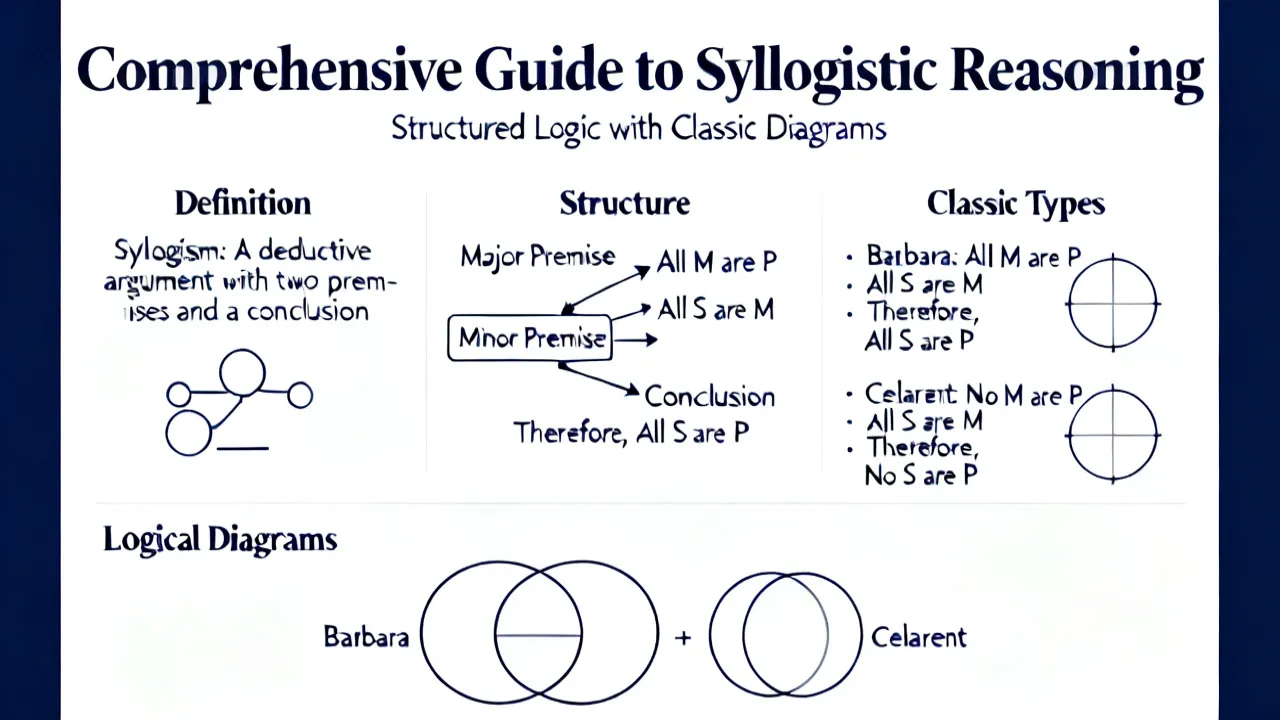
Silogism, an integral component of logical reasoning, serves as a crucial tool for both philosophers and logicians. Rooted in the works of Aristotle, syllogisms are structured arguments that form the basis for deductive reasoning. This article explores the components that define syllogism—major premise, minor premise, and conclusion—and their implications in contemporary analytical discourse. The ability to construct and deconstruct syllogisms promotes critical thinking skills that are essential not only in philosophy but also in daily decision-making processes.
Syllogisms are logical structures composed of three parts: two premises and a conclusion. The premises provide the foundational truths or assumptions, while the conclusion is the logical result derived from these premises. The clarity of this structure is what makes the syllogism a powerful tool in logical reasoning. Consider the classical example:
Major Premise: All humans are mortal.
Minor Premise: Socrates is a human.
Conclusion: Therefore, Socrates is mortal.
This structure exemplifies the simplicity and effectiveness of syllogisms, highlighting the necessity for premises to be true in order for the conclusion to hold logically. Each part plays a critical role in ensuring that the argument presented is coherent and solid. The syllogistic form is not just a trivial arrangement of statements; it reflects a rigorous approach to thinking that encourages clarity and precision in reasoning.
Originating in the works of Aristotle, a Greek philosopher, syllogistic reasoning has been pivotal in the evolution of Western philosophy. Aristotle's syllogistic logic formed the foundation for medieval scholastic thinking, influencing schools of thought from the Middle Ages through the Renaissance. His contribution laid the groundwork for modern logic systems, emphasizing clear and precise argumentation.
Aristotle's "Prior Analytics" introduced the rules that govern syllogistic reasoning, establishing a framework that enables the analysis of arguments for validity and soundness. This historical foundation is not merely of academic interest; it continues to inform contemporary philosophy and logic. Subsequent philosophers, including Thomas Aquinas, further expanded on Aristotle's work, applying syllogistic reasoning to theological arguments, thereby cementing its place in the legacy of Western intellectual history.
While the basic structure of syllogism remains unchanged, its application has expanded across various fields, proving its relevance in the modern world. From computer science and artificial intelligence to legal reasoning and philosophical debates, syllogisms serve as an indispensable tool for structured analytical thinking. They allow practitioners to break down complex scenarios into manageable, logical sequences. For instance, in computer science, programmers utilize syllogistic logic when creating algorithms that require decision-making based on sequential input data.
Moreover, in the field of artificial intelligence, syllogisms underpin many of the programming techniques used to emulate human-like reasoning. AI systems often use algorithmic logic similar to syllogistic reasoning to deduce outcomes based on a set of premises, enabling them to solve problems ranging from simple tasks to complex computations. Legal reasoning also significantly benefits from syllogistic structures, as lawyers construct their arguments by connecting laws and precedents to reach just conclusions.
Understanding how syllogisms work can be enriched by exploring their diverse use in various contexts, including mathematics, linguistics, and law. In mathematics, syllogistic logic can manifest in proofs and theorem-building processes, where general principles lead to specific instances, much akin to mathematical induction. Linguistics also employs syllogistic structures to analyze semantic relations between concepts, elucidating how language conveys logical relationships.
In legal arguments, syllogistic reasoning aids in stringing together evidence and legal precedents to derive judicial conclusions. An attorney may argue:
Major Premise: If evidence is presented, then the court must consider it.
Minor Premise: The evidence of the defendant's alibi has been presented.
Conclusion: Therefore, the court must consider the defendant's alibi.
This application illustrates how syllogisms can influence real-world outcomes and decisions in significant ways. Similarly, in political discourse, politicians and advocates often employ syllogistic reasoning in persuading their audiences, framing their arguments in ways that clearly outline cause and effect, thereby enhancing their rhetoric.
One of the crucial aspects of syllogistic reasoning is ensuring argument validity. The validity of a syllogism depends on its form rather than the truth of its premises. An argument might be valid if structurally sound, even when the premises are factually incorrect. For instance:
Major Premise: All birds can fly.
Minor Premise: Penguins are birds.
Conclusion: Therefore, penguins can fly.
Although the premises lead logically to the conclusion, the factual inaccuracy in one premise weakens the argument’s soundness. This distinction between validity and soundness is pivotal in critical thinking; a valid syllogism can still lead to false conclusions if based on false premises, necessitating a thorough examination of the premises used to construct logical arguments.
| Component | Description |
|---|---|
| Major Premise | A general statement or hypothesis that sets the stage for the argument. |
| Minor Premise | A specific claim relating to the major premise, typically an instance or example. |
| Conclusion | A logical result derived from the premises, serving as the culmination of the argument. |
Despite their power, syllogisms present several challenges, including issues related to ambiguity, equivocation, and relevance of premises. A common pitfall involves assuming that structurally valid arguments are necessarily truthful. Effective syllogistic reasoning demands critical assessment of both form and content.
Ambiguity can arise from vague terms in premises, leading to confusion in the conclusion. For instance, if an argument states:
Major Premise: All bank officials are trusted individuals.
Minor Premise: John is a bank official.
Conclusion: Therefore, John is a trusted individual.
The term "trusted" is ambiguous and may vary in interpretation depending on the context. Such ambiguity can obscure the intended meaning and undermine the effectiveness of the syllogism. Similarly, equivocation, where a word is used with different meanings in the premises, can skew the conclusion. It is crucial to ensure clarity in the language used to prevent misinterpretation.
In conclusion, mastering syllogisms enhances one's ability to reason effectively and critically. They represent more than mere abstract constructs; they underpin the very methodology of methodical thinking that pervades multiple domains. Whether in philosophy, law, or technology, all centered on structured, precise logic, aspiring scholars and professionals alike benefit from understanding and applying syllogistic principles within their respective fields. By leveraging these structures, individuals can navigate complex arguments, avoid common logical fallacies, and achieve more lucid and persuasive communication.
To solidify an understanding of syllogisms, practical exercises can be incredibly beneficial. These exercises can range from constructing syllogisms based on provided scenarios to analyzing existing arguments for their validity and soundness. Below are several exercises that readers can undertake to enhance their skills in syllogistic reasoning:
Given the following major premise, create a minor premise that results in a valid conclusion:
Major Premise: All mammals are warm-blooded.
Once you formulate a minor premise, write down the conclusion that logically follows. This exercise assesses your ability to connect premises accurately.
Take the following syllogism and analyze whether it is valid or invalid by assessing the structure:
Major Premise: All trees bear fruit.
Minor Premise: An oak is a tree.
Conclusion: Therefore, an oak bears fruit.
Determining whether the argument is valid requires careful consideration of the premises and how they relate to one another. Reflect on whether the conclusion necessarily follows from the premises.
Review this syllogism and identify any errors or ambiguities present:
Major Premise: Some politicians are honest.
Minor Premise: John is a politician.
Conclusion: Therefore, John is honest.
What makes this conclusion potentially flawed? This task encourages thinking critically about assumptions and generalizations.
Create a syllogism based on a real-world situation involving a decision you have to make. Identify the major premise, minor premise, and valid conclusion. This will allow you to practice applying logical reasoning to practical scenarios.
The implications of mastering syllogistic logic extend well beyond academic exercises; they play a significant role in everyday decision-making and problem-solving. In an era characterized by information overload, the ability to dissect arguments and anticipate potential fallacies is more critical than ever. Whether engaging in political discourse, navigating social media discussions, or tackling complex scientific questions, the skills developed through syllogistic reasoning—such as clarity of thought, precision in language, and logical consistency—empower individuals to contribute meaningfully to these conversations.
As we continue to evolve in our understanding of logic and reasoning, it is important to recognize that syllogisms represent just one tool in a broader toolkit of critical thinking strategies. Embracing these principles enriches our capacity for rational thought, fostering not only better decision-making but also encouraging us to cultivate a habit of continuous inquiry.
For those looking to delve deeper into the world of syllogistic reasoning, the following resources can provide valuable insights and guidance:
In conclusion, mastering syllogisms and the principles of logical reasoning is not a finite task but a lifelong journey of intellectual growth. Engaging with syllogistic reasoning equips individuals with the foundational skills necessary for robust critical thinking, enriching both personal and professional spheres. Whether in discourse, decision-making, or creative problem-solving, the clarity and precision afforded by logical frameworks enable individuals to navigate complexities with confidence.
As you continue to explore and practice syllogistic reasoning, remember that the lessons learned apply universally across contexts—whether in academic settings, workplace environments, or everyday conversations. Cultivating these skills fosters not only better reasoning but also empathy and understanding in a world increasingly in need of thoughtful discourse.