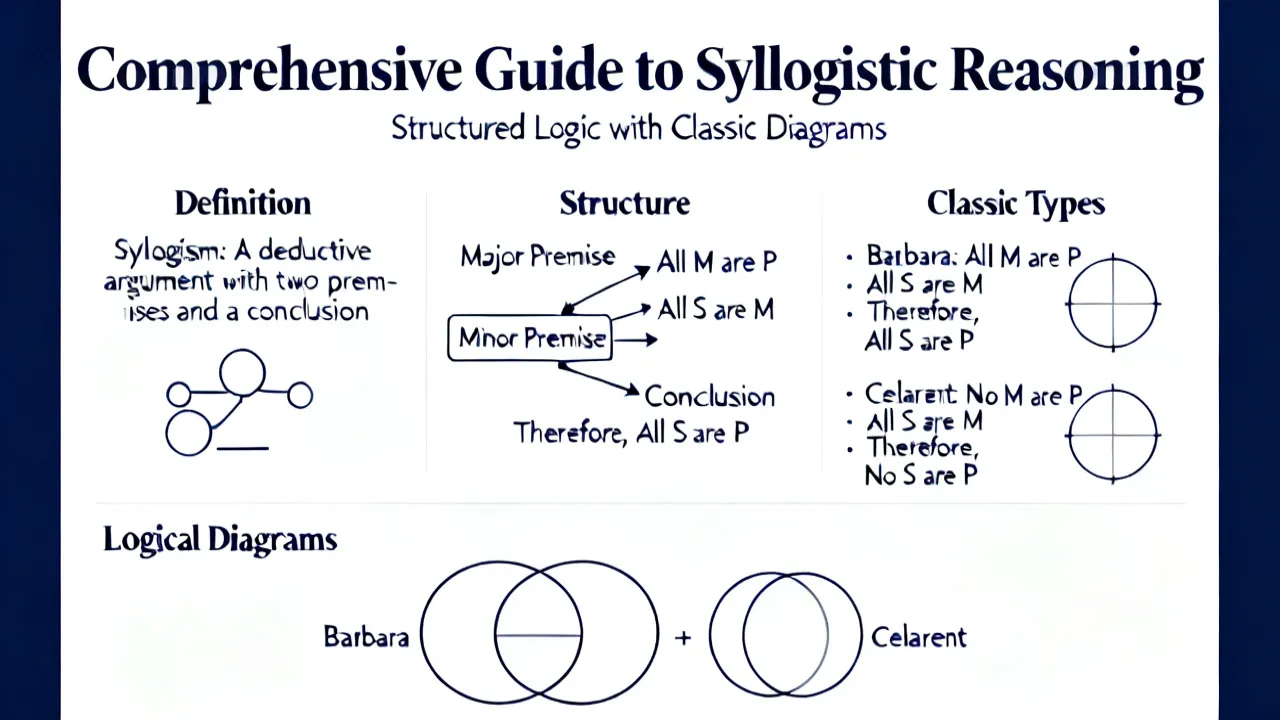
This guide unpacks the rich concept of silogism, fundamental to logical reasoning and critical thinking. Originating from ancient Greek philosophy, silogism remains pivotal in developing human cognition by enabling individuals to draw inferences from given premises. This article delves into its historical significance, application in modern contexts, and why mastering silogism enhances analytical skills.

Logic forms the bedrock of human reasoning, aiding in the systematic evaluation of arguments and propositions. At the heart of logical discourse lies the concept of silogism, a cornerstone introduced by Aristotle. Silogism facilitates the deduction of conclusions from two or more premises that are asserted to be true. This process is not merely an academic exercise; it is essential for critical thinking and decision-making in various fields. It serves as a pivotal stepping stone toward developing sound reasoning skills and promoting intellectual discourse. By comprehensively understanding silogism, individuals can better navigate the complexities of arguments they encounter, whether in academic arenas, casual debates, or professional environments.
Originating in ancient Greece, silogism quickly became the paradigm of logical deduction. Aristotle, the father of formal logic, meticulously categorized it into various forms, enhancing the understanding of relational thought processes. Aristotle's work on silogism laid the groundwork for understanding deductive reasoning, allowing scholars and thinkers to communicate complex ideas clearly and systematically. Over the centuries, scholars expanded upon his foundations, reinforcing silogism’s relevancy even in today's technologically advanced world. Various cultures and philosophical schools, including those in India and China, made unique contributions to the evolution of logic, demonstrating that the quest for rigorous reasoning spans across civilizations.
Though rooted in ancient thought, silogism finds its place in today’s diverse array of disciplines. In fields such as computer science, silogistic logic is foundational for developing algorithmic structures. Software engineers rely on logical reasoning to write efficient code and debug programs effectively. Legal experts utilize it to build cogent arguments in court, where the clarity of reasoning can significantly impact case outcomes. Medical professionals apply it to diagnose patients through symptomatic analysis, systematically evaluating the information they gather to reach sound conclusions about patient care. The judiciary system also heavily employs silogistic reasoning to assess the validity of laws and the coherence of legal arguments, emphasizing its importance in upholding justice. Additionally, political discourse often hinges on silogism, as politicians and analysts use logical frameworks to formulate policies, critique opposition arguments, and engage the public in substantive debate.
Mastering silogism is vital for strengthening analytical capabilities. By employing this logical structure, individuals enhance their ability to determine the validity of statements and arguments, leading to sounder conclusions. This skill is invaluable in both professional and personal contexts, aiding in solving complex problems and making informed decisions. In a consumer’s world filled with advertisements and persuasive communications, the ability to dissect arguments critically allows individuals to discern credible information from mere persuasion. Furthermore, silogism enhances intellectual engagement within communities, encouraging debates based on reason rather than emotion. The structured approach of silogism equips individuals to tackle abstract ideas, making them confident in their capacity to promote and defend their viewpoints while remaining open to others’ perspectives.
Beyond academia and professional practice, silogism can be a potent tool for everyday situations. Whether deciding the most efficient route home or evaluating the credibility of a news source, silogism helps in structuring thoughts and outcomes logically. For instance, when faced with the proposition that “All traffic jams are caused by road construction. This road has construction. Therefore, this road will likely have a traffic jam,” the application of silogistic reasoning can streamline decision-making processes, guiding individuals to consider alternative routes proactively. By consistently applying logical frameworks, individuals can cultivate a habit of critical thinking that transcends specific instances and permeates daily actions.
Silogism consists of three crucial components: the major premise, the minor premise, and the conclusion. The major premise provides a general statement, the minor premise offers a specific fact or observation, and the conclusion combines the two premises to form a logical inference. This triadic structure is essential for formulating valid arguments and is a powerful tool in encouraging clear thought organization. The major premise establishes the broader context, while the minor premise narrows down the focus and specifics, culminating in a conclusion that follows logically from both premises. This structure not only enhances clarity in communication but also cultivates a mindset oriented toward systematic reasoning.
| Type | Example | Explanation |
|---|---|---|
| Classic Silogism | All humans are mortal. Socrates is a human. Therefore, Socrates is mortal. | This classic example illustrates how assumptions lead to an inevitable conclusion based on the premises provided. |
| Hypothetical Silogism | If it rains, the ground will be wet. It is raining. Therefore, the ground is wet. | This form relies on conditional propositions to reach a logical conclusion, demonstrating how premises work together to yield an actionable insight. |
| Disjunctive Silogism | You will either pass the exam, or you will not. You did not pass the exam. Therefore, you will not pass. | This type uses an either-or scenario, leading to a conclusion based on the exclusion of one option. |
| Constructive Silogism | If you study hard, you will pass the exam. You studied hard. Therefore, you will pass the exam. | This example illustrates a cause-and-effect relationship, encapsulating how actions lead to specific outcomes. |
The interplay between silogism and critical thinking is profound. Critical thinking entails analyzing and evaluating an argument to identify its strengths, weaknesses, and validity. Silogism offers a structured approach that underpins effective critical thinking. When individuals apply silogism, they not only deduce conclusions but also refine their ability to dissect arguments critically. This skill is heightened through practice and reflection. Engaging in discussions that require the application of logical reasoning cultivates an environment where critical thinking can flourish. This process transforms individuals into better decision-makers, equipped to navigate the intricacies of human dialogue and reasoning.
Silogism holds significant educational implications, particularly in the teaching of logic, philosophy, and related disciplines. Incorporating syllogistic reasoning into curricula at various educational levels promotes logical literacy among students. By learning to structure their arguments logically, students develop skills that enhance their academic performance across subjects. This logical foundation encourages disciplined thought, fostering curiosity and enhancing the capacity for independent reasoning. Notably, educational methods that incorporate technology and digital platforms can create adaptive learning environments where students practice syntactic scholarship through interactive syllogistic exercises. Such engagement not only strengthens their understanding of logic but also prepares them to tackle real-world problems with a rational mindset.
The influence of silogism on public discourse is significant, especially in an age where information is disseminated rapidly through various media channels. In news outlets, advertising, and political speeches, the use of logical reasoning is essential for persuading and informing the public. Journalists often employ syllogistic frameworks to structure their reports, ensuring clarity and coherence in the relay of information. Likewise, political figures utilize syllogism to craft persuasive arguments, framing their policies and decisions in a logical light. By critically analyzing these arguments, the public becomes more discerning consumers of information, empowered to engage in civil debate grounded in reason rather than mere rhetoric.
Despite its many advantages, silogism is not without its challenges and limitations. One of the primary issues arises from the validity of premises; if the premises are flawed or based on assumptions, the conclusion, however logically derived, may also be false. Furthermore, real-world situations often involve complexities and ambiguities that cannot be adequately addressed by strict syllogistic frameworks. In some instances, emotion and subjective experiences significantly influence human decision-making, which may contradict logical reasoning. Therefore, it is vital to recognize the limitations of silogism while striving for a balanced approach that incorporates both logical rigor and awareness of human behavior.
The increasing integration of silogistic logic into the realms of artificial intelligence (AI) and machine learning reflects its relevance in the contemporary technological landscape. Algorithms utilize logical structures to process and analyze data, drawing conclusions based on established premises. For instance, in natural language processing, AI systems are designed to understand and interpret human language logically. This involves parsing sentences and discerning syllogistic relationships to grasp meaning and context accurately. As machine learning continues to evolve, the crux of effective AI also lies in its ability to reason like humans, an endeavor that increasingly draws from syllogistic principles.
The philosophical dimensions of silogism also merit exploration, particularly regarding epistemology. How do we know what we know? Silogism plays a fundamental role in epistemological discussions, serving as a representation of how knowledge can be deduced and structured logically. Philosophers from various traditions have engaged with the implications of silogism, debating its strengths and weaknesses in their quest for truth and understanding. Through this analytical lens, silogism transcends mere argumentation; it becomes part of a broader discourse about evidence, belief, and rationality in philosophical inquiry.
In an era dominated by information and technology, the ability to think logically and critically has never been more essential. Silogism serves as a timeless method for honing these skills, providing a robust framework for reasoning and argumentation. Whether you're a student, professional, or merely someone intrigued by logic, embracing silogism can profoundly influence your thinking process and comprehension. By engaging with silogistic principles, individuals can navigate the complexities of human thought, refine their reasoning abilities, and contribute meaningfully to societal discourse. In essence, comprehending and applying silogism not only enriches individual thought processes but also enhances collective intelligence, fostering environments conducive to productive and informed dialogue.