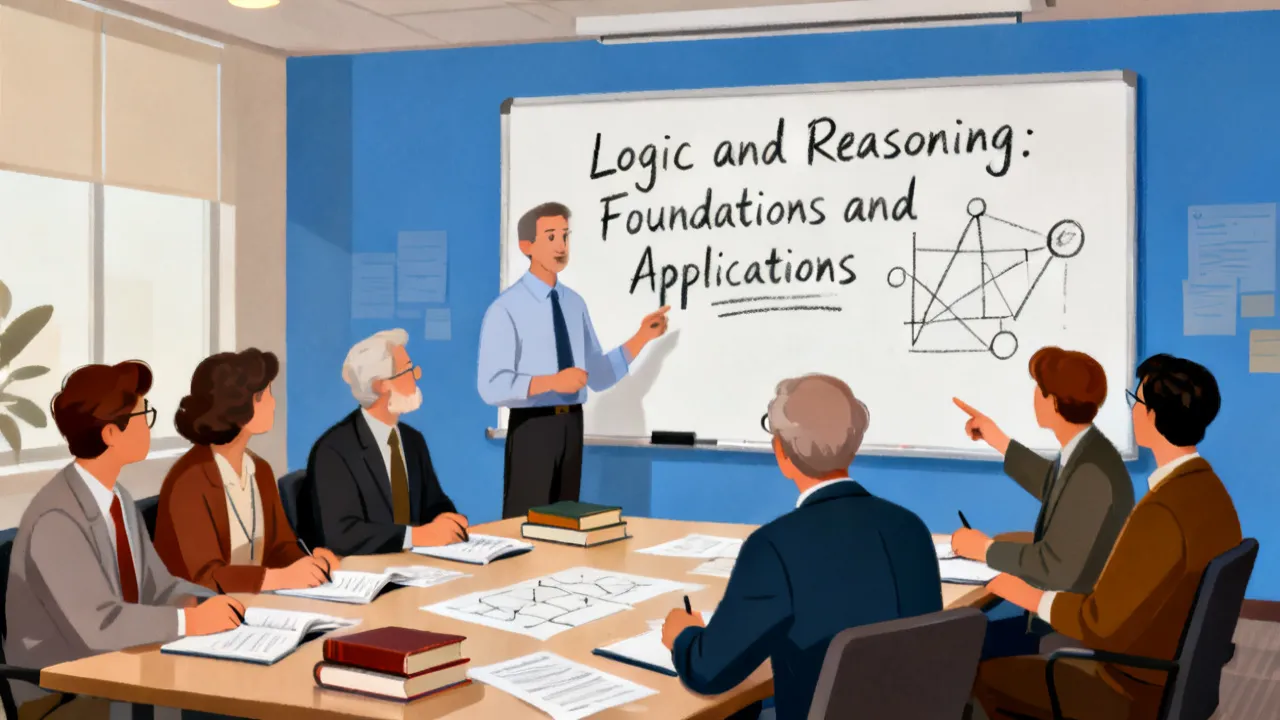
Syllogism, a foundational element of logical reasoning, plays a pivotal role in deductive reasoning by presenting arguments in structured formats. Originating from the works of Aristotle, syllogism is part of classical logic, where conclusions are drawn from two linked premises. This article explores its applications, significance, and variations in modern discourse, offering an in-depth understanding of its role in reasoning and argumentation.

The concept of syllogism, introduced by Aristotle in ancient Greece, remains a cornerstone in the study of logic and philosophy. Syllogism is defined as a kind of logical argument where a conclusion is drawn from two given or assumed propositions (premises). Each premise shares a common term with the conclusion, allowing the reasoning process to equate or relate terms logically. This ancient tool of reasoning not only helps in deriving conclusions within specific contexts but also lays the groundwork for more complex forms of logical analysis and reasoning that scholars and philosophers have built upon.
In a typical structure, a syllogism consists of a major premise, a minor premise, and a conclusion. For example, consider:
This straightforward example illustrates how syllogisms function fundamentally. The categorical nature of the premises allows for a logical stream where if the premises are true, the conclusion must be true as well. This aspect highlights the power of syllogism in reducing complex ideas into elemental truths that can be easily scrutinized and understood.
Syllogism serves as an effective tool in deductive reasoning, wherein the truth of the premises logically guarantees the truth of the conclusion. It serves as a foundation for constructing sound arguments, making it essential in various disciplines such as mathematics, computer science, philosophy, and even everyday reasoning. The rigor associated with syllogistic reasoning fosters clarity in argumentation and ensures that each assertion is examined and validated according to logical standards.
Moreover, syllogisms help clarify complex ideas by breaking them down into simpler components, facilitating better understanding and discussion. In academic contexts, syllogistic reasoning is not merely a theoretical exercise, but a practical framework for enhancing critical thinking. For students, mastering the art of syllogistic reasoning improves argumentation skills and equips them to tackle abstract concepts efficiently. This formal method of reasoning encourages clarity of thought and comprehension essential not only for academic achievement but also for effective communication in professional spheres.
In modern academia and professional environments, this method aids in presentation logic, scientific hypothesis formulation, and legal reasoning, ensuring that conclusions drawn are well-founded and backed by valid premises. For instance, in legal contexts, attorneys often utilize syllogistic reasoning to structure their arguments in a way that persuades judges and juries about the validity of a claim. This logical framework builds a case to support their positions and helps navigate complex legal waters.
There are several types of syllogisms used to evaluate various forms of reasoning. These include:
Though syllogism is a classical concept, its applications extend into contemporary settings. In artificial intelligence, algorithmic problem-solving, and circuit design, syllogistic principles are adapted to create efficient solutions. Syllogisms enable the encoding of relationships and logical operations within complex systems, aiding machines in rendering human-like decision-making processes. For example, in knowledge-based systems, logical rules modeled after syllogistic reasoning facilitate inference and knowledge retrieval.
Furthermore, in educational curricula around the world, syllogistic reasoning is incorporated to improve critical thinking and analytical skills among students. Schools teach syllogism as part of logic or philosophy courses, making it an integral component of educational methodologies that aim to cultivate logical reasoning skills necessary for navigating an increasingly complex world. Students engage in exercises that involve creating their syllogisms, identifying logical fallacies, and analyzing arguments to develop their reasoning capabilities.
In corporate settings, syllogisms play a vital role in decision-making processes where logical consistency and valid argumentation are desired outcomes. Managers and business leaders utilize syllogistic reasoning to construct strategic plans, analyze risks, and solve problems. By establishing clear premises and drawing sound conclusions, organizations can enhance their operational effectiveness and make informed decisions that contribute to their success.
| Model of Logic | Description | Application |
|---|---|---|
| Syllogism | A form of reasoning with two premises leading to a conclusion. | Philosophy, Mathematics, Law |
| Inductive Reasoning | Draws general conclusions from specific examples. This type of reasoning often involves observing patterns and making generalized claims, which can be useful in forming hypotheses and theories. | Scientific Research, Hypothesis Development |
| Abductive Reasoning | Formulates explanations based on available evidence. This method frequently leads to the most likely or best explanation for a given set of observations and is commonly seen in diagnostic processes. | Diagnostics, Problem Solving |
While syllogisms are a powerful tool for logical reasoning, they can also be susceptible to various fallacies that weaken their validity. Understanding these fallacies is essential for anyone seeking to master syllogistic reasoning. Here are some common logical fallacies associated with syllogism:
By critically analyzing syllogisms for such fallacies, one can hone logical reasoning skills and construct more robust arguments.
A syllogism is a form of logical argument that derives a conclusion from two premises sharing a common term, allowing for clear and systematic reasoning.
Syllogism is deductive, starting from general statements and leading to specific conclusions, unlike induction or abduction, which follow different approaches by deriving principles from specific instances or reasoning in the most likely ways, respectively.
Yes, by structuring arguments logically, syllogisms aid in making consistent and reasoned decisions. Individuals often use syllogistic reasoning unconsciously in daily life situations, such as determining the validity of claims or proposals.
Indeed, syllogisms are utilized in various fields like artificial intelligence, where they inform algorithms for decision-making; in law, for constructing legal arguments; and in business, for strategic planning.
Syllogistic reasoning cultivates critical thinking in students, as it necessitates the ability to analyze premises, construct logical arguments, and recognize fallacies, thereby promoting sound argumentative skills crucial for academic and career success.
In conclusion, syllogisms offer a timeless framework to structure arguments logically and methodically that continues to hold relevance across various domains. Mastery of syllogistic reasoning empowers individuals to dissect arguments critically and strengthen their reasoning capabilities. As our world grows more complex, the need for clear and rational thinking becomes ever more crucial, reaffirming the enduring legacy of syllogism in intellectual exploration and decision-making. The ability to construct valid arguments enhances communication, fosters collaboration, and nurtures problem-solving skills essential in both personal and professional spheres.
To further understand the versatility of syllogism, consider the following advanced examples that illustrate different types of syllogistic reasoning:
1. Major Premise: All birds have feathers.
2. Minor Premise: A sparrow is a bird.
3. Conclusion: Therefore, a sparrow has feathers.
This syllogism demonstrates a clear categorical relationship, whereby the conclusion naturally follows from the premises established. Each component connects logically and successfully conveys a fact derived from categorized information.
1. Major Premise: If a student studies hard, then they will pass the exam.
2. Minor Premise: Maria studied hard.
3. Conclusion: Therefore, Maria will pass the exam.
This example showcases how conditional reasoning operates. It allows the premises to establish a condition where fulfilling the first premise logically leads to the fulfillment of the consequent.
1. Major Premise: Either it is raining or it is sunny.
2. Minor Premise: It is not sunny.
3. Conclusion: Therefore, it is raining.
This illustrates the “either-or” structure wherein the elimination of one possibility confirms the truth of the other. This type of syllogism helps to narrow down scenarios and clarify understanding in decision-making contexts.
The examples not only aid in understanding syllogistic structures but also underscore their importance in logical reasoning across different scenarios. Whether in classroom discussions, philosophical debates, or in business strategies, syllogisms help clarify positions, illuminate complexities, and lead to valid conclusions based on sound premises. As practical tools, syllogisms empower individuals to communicate persuasively, think critically, and maintain a rational approach in both their personal and professional lives.