Syllogism is a form of deductive reasoning that works by drawing conclusions from two given or assumed propositions, known as premises. This method, often used in logic and philosophy, serves as the foundation for crafting sound arguments and understanding logical connections. Through the examination of different types of syllogisms, one gains insights into the nuanced art of reasoning.
Syllogism serves as a fundamental aspect of logic and philosophy. By understanding syllogism, individuals can better analyze logical arguments and deduce conclusions from established premises. This ancient method of reasoning can be traced back to Aristotle, who formalized its principles in his work on logic. In essence, syllogism involves deriving a conclusion based on two given or assumed statements or premises. The application of syllogism can be seen across various fields, emphasizing its significance in critical thinking and structured reasoning.
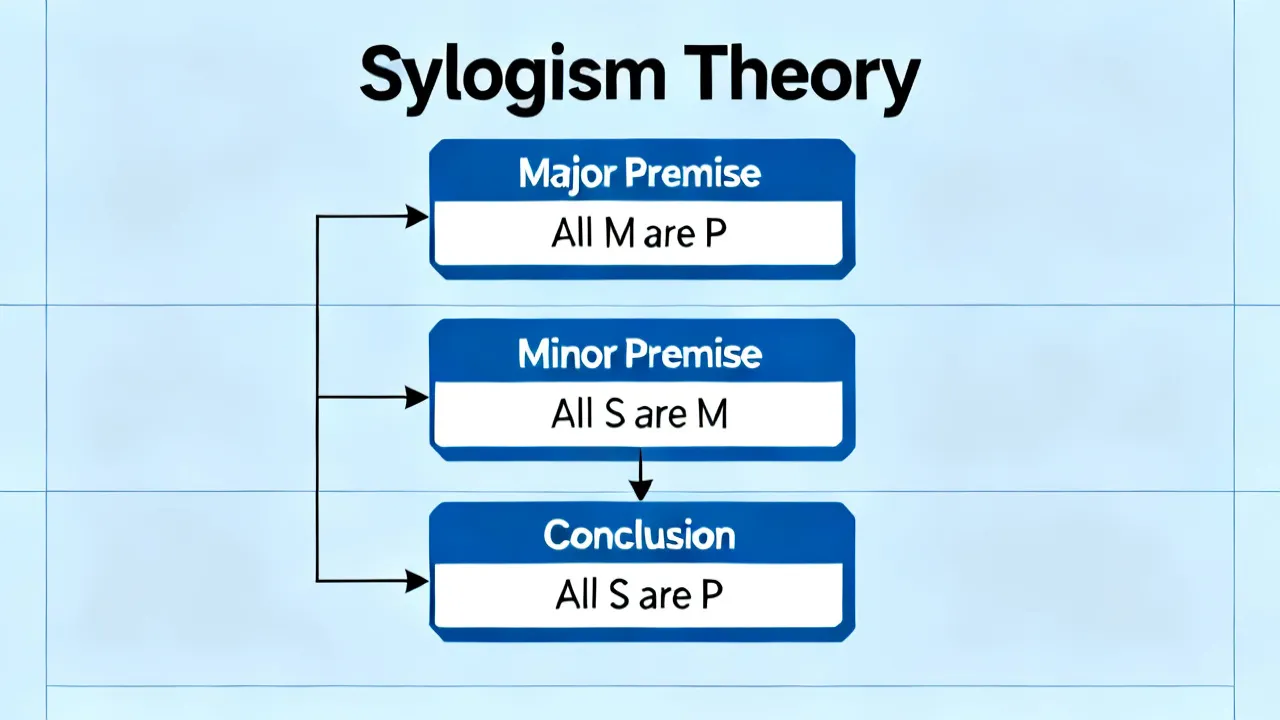
A typical syllogism comprises three parts: a major premise, a minor premise, and a conclusion. For example:
This structure reveals how the logical interplay of premises leads to a definitive conclusion. Each syllogism must follow a logical format, ensuring both premises are accurate for the conclusion to be valid. There are different types of syllogisms, including categorical, hypothetical, and disjunctive syllogisms, each serving its unique purpose in logical reasoning.
The examination of syllogism also reveals the importance of terms used within premises. The terms can be universal (applying to all), particular (applying to some), or singular (applying to one specific instance). Understanding the classification of these terms helps elucidate how more complex logical arguments are formed and analyzed.
Categorical Syllogism: This form deals with statements that categorize subjects. It often uses universal quantifiers like 'all', 'some', or 'none.' For instance, the argument structure:
This example emphasizes the relationship among categories and supports the ability to reason within defined classifications or groups.
Hypothetical Syllogism: This type contains a conditional aspect, such as 'if A then B.' The structure relies on the fulfillment of the condition for the conclusion to hold. Consider the following example:
Here, the hypothetical nature of the premises illustrates how conditional reasoning applies to situations that are dependent on specific circumstances.
Disjunctive Syllogism: This involves reasoning between two alternatives. It operates on the principle that if one alternative is false, the other must be true. An example of this would be:
Disjunctive syllogisms show the importance of exclusivity between options, leading to a decisive conclusion based on eliminating one alternative.
Mastering syllogism is crucial for anyone interested in enhancing their critical thinking and reasoning skills. Whether in academic settings, legal practices, or everyday decision-making, the ability to evaluate premises and reach logical conclusions is invaluable. Understanding syllogism also aids in the identification of fallacies, helping individuals establish well-founded arguments. The methodology of syllogism cultivates critical analytical skills, empowering individuals to question assumptions and investigate the coherence of their reasoning.
In educational contexts, syllogism encourages students to think logically and systematically, nurturing an environment that values structured thought processes. This not only improves their problem-solving capabilities but also fosters a deeper understanding of philosophical discussions and ethical dilemmas. Each syllogistic form can reveal the facets of an argument, offering insights into its overall validity and implications.
In today's world, syllogism remains relevant across various fields, from artificial intelligence and computer science to negotiation and mediation. Computers use logical reasoning based on syllogistic principles to perform tasks, while professionals employ them to structure their arguments and assess the validity of information. In artificial intelligence, for example, algorithms often rely on logical constructs similar to syllogistic reasoning to make decisions based on the input data they receive.
Moreover, in law and ethics, syllogism helps lawyers articulate their arguments convincingly by providing a clear pathway from premises to conclusion. Legal reasoning often involves syllogistic structures, especially when lawyers address statutes or precedents to support their cases. This practice allows for a thorough examination of conflicting positions and enhances the adjudication process by promoting clarity and rigour in arguments presented within the courtroom.
The realm of negotiation also benefits from syllogistic reasoning, enabling negotiators to frame their proposals effectively. By establishing common ground through shared premises, negotiators can facilitate more productive discussions and arrive at mutually beneficial conclusions. The clarity provided by syllogistic argumentation fosters understanding among parties and promotes an atmosphere conducive to agreement.
| Type | Description | Example |
|---|---|---|
| Categorical | Involves universal statements about a category. | All cats are animals; some animals are pets; therefore, some cats are pets. |
| Hypothetical | Contains conditional 'if-then' statements. | If it rains, the ground will be wet; it is raining; therefore, the ground is wet. |
| Disjunctive | Utilizes an either-or format to derive conclusions. | The light is either on or off; it is off; therefore, it is not on. |
Understanding syllogism can be hindered by various misconceptions. One prevalent misunderstanding is the belief that a syllogism must always yield true conclusions. While the logical form can be valid, it does not guarantee the truth of the conclusion if the premises are false. For example:
Despite the syllogism being valid structurally, the premises' falsehood leads to a false conclusion. Recognizing this distinction is crucial for effectively applying syllogistic reasoning.
Another misconception is that all syllogisms must be composed of strictly categorical statements. While categorical syllogisms are among the most common, hypothetical and disjunctive syllogisms also play essential roles in logical reasoning, illustrating that syllogistic reasoning can encompass a broader range of statements and formats.
The principles of syllogism extend beyond theoretical discussions; they manifest in countless practical applications. In medicine, for instance, doctors frequently use syllogistic reasoning when diagnosing illnesses. They might say:
This structured approach aids healthcare professionals in making informed decisions based on existing knowledge and evidence.
Similarly, in business contexts, leaders utilize syllogism when crafting strategic plans or marketing strategies. By establishing core premises about consumer behavior or market trends, they can logically deduce conclusions that guide decision-making. For example:
Such applications showcase how syllogistic reasoning helps form effective strategies based on logical deductions, reinforcing the significance of sound reasoning in various ventures.
A critical aspect of mastering syllogism is the ability to identify and analyze logical fallacies. Many fallacies can arise during syllogistic reasoning, undermining the argument's credibility. Common fallacies associated with syllogism include:
Affirming the Consequent: This fallacy occurs in hypothetical syllogisms when someone infers the antecedent from a true consequent:
This reasoning is flawed, as other factors could cause the ground to be wet, illustrating the necessity of scrutinizing the connection between premises and conclusion.
Denying the Antecedent: This fallacy involves incorrectly asserting that the absence of the antecedent negates the consequent:
Again, this line of reasoning is invalid, demonstrating the importance of recognizing potential alternative causes or conditions.
By learning to identify these and other fallacies, individuals can sharpen their analytical skills, improving their ability to craft and evaluate arguments effectively.
Question: What is the role of premises in a syllogism?
Answer: Premises are foundational statements that support the conclusion of a syllogism. Their validity determines the overall soundness of the argument and shapes how conclusions are formed based on the established premises.
Question: Can a syllogism be valid but not true?
Answer: Yes, a syllogism can be structurally valid, meaning the conclusion logically follows from the premises, but if the premises are false, the conclusion will also be false, even though the argument is valid. This distinction is crucial for effective logical analysis.
Question: How can syllogism help in argumentation?
Answer: Syllogism enhances argumentation by providing a clear framework to evaluate the relationship between premises and the conclusion, aiding in constructing coherent and logically sound arguments. This structured approach enables individuals to navigate complexities in discussions and make persuasive points grounded in logical reasoning.
Question: Are there any limitations to using syllogism?
Answer: While syllogism is a powerful tool for logical reasoning, it does have its limitations. It is not always applicable to arguments that involve subjective opinions or value judgments. Moreover, syllogisms may oversimplify complex situations into binary premises, potentially ignoring nuances or contributing factors that impact the conclusion.
In conclusion, the understanding of syllogism not only enhances one's logical reasoning capabilities but also equips them with critical tools indispensable in an array of professional fields. Whether employed to resolve complex dilemmas or debate theoretical principles, syllogism remains an enduring pillar of effective reasoning. Its applications extend from academia to law, healthcare, and beyond, empowering individuals to navigate the intricacies of arguments and make informed decisions.
As we grow in our ability to harness the power of syllogistic reasoning, we not only improve our analytical prowess but also contribute to a more rational and evidence-based discourse in society. The principles of syllogism resonate in everyday decisions, discussion within the public forum, and crucial business negotiations alike. To master syllogism is to embrace clearer thinking and robust argumentation, forming the foundation of persuasive communication and logical analysis that is vital in our increasingly complex world.
As society progresses into an era defined by rapid technological advancement and information proliferation, the importance of syllogistic reasoning will only increase. The ability to discern logical fallacies in a sea of information, to derive sound conclusions from ambiguous data, and to present structured arguments will constitute essential skills in various domains. In the field of education, the integration of syllogistic principles into curricula can prepare future generations for critical engagement with information and debate.
In philosophy, thinkers will continue to explore and expand upon the principles established by Aristotle, potentially leading to new forms of reasoning that adapt to modern contexts and challenges. Syllogisms may intersect with emerging fields such as data science and machine learning, where logic and reasoning are crucial to developing algorithms capable of complex decision-making.
Ultimately, as we reflect on the foundational role of syllogistic reasoning in logic and philosophy, it becomes evident that its principles have widespread relevance. The capacity to think critically, deduce sound conclusions, and communicate effectively lays the groundwork for progress in every field. Thus, delving deeper into syllogism not only aids individual development but also enriches the societal discourse necessary for innovation, understanding, and collective advancement.